Growing Chinese Fragrant Taro in Tokyo
🏠 Trying to Grow a Taste of Home
Taro — specifically the fragrant, floury kind common in southern Chinese cooking — is one of those tastes I grew up with. It just quietly appeared on the table: steamed taro braised with pork belly, sweet taro dessert soups, piping-hot taro cakes straight from the kitchen. In Guangdong, Guangxi, and Fujian, this type of taro is so ordinary it hardly needs an introduction. It's just food.
After moving to Tokyo, the closest thing I could find in supermarkets was satoimo (里芋) — the small, soft Japanese taro that turns slightly slippery when cooked. A fine vegetable, but not the same thing. Occasionally a Chinese grocery store would carry frozen Chinese taro, but it never tasted quite like I remembered. So last year, I decided to grow it myself.
It was partly an experiment, partly a small act of stubbornness: can you actually grow this in Tokyo? Spring here doesn't warm up as quickly as Guangdong. Winters are cold, and frost would kill the plants. Rainfall feels different. Would it even adapt? With those questions in mind, I bought two seedlings and got started.
🔍 What Is Chinese Fragrant Taro?
If you didn't grow up in southern China, this vegetable might not be familiar, so a quick introduction.
The taro I'm talking about is called xiāngyù (香芋) in Chinese — literally "fragrant taro." The most well-known varieties include Lipu taro (荔浦芋) from Guangxi and binlang taro (槟榔芋) from Guangdong and Fujian. These are large, starchy tubers — quite different from the small satoimo familiar in Japan. Cut one open and you'll often see beautiful purple marbling through the white flesh.
The texture after cooking is dry and floury — closer to a good sweet potato than to satoimo — with a distinctive, slightly nutty aroma. That fragrance is exactly why it's so popular in southern Chinese sweets and pastries.
In practice, you'll find it braised with pork belly, stewed with spare ribs, cooked into taro rice, blended into smooth taro paste (芋泥) for desserts, or stirred into taro milk tea. If you've ever had a well-made taro dessert and wondered where that earthy sweetness comes from, this is likely the ingredient.
If you enjoy satoimo, there's a good chance you'll like Chinese fragrant taro too — it just offers a different texture and a more pronounced flavour.
🌿 Varieties: Not All Taro Is the Same
The term "Chinese fragrant taro" is a loose one, but it generally refers to large-type taro varieties with strong fragrance and a dry, starchy texture. The main ones are:
- Binlang taro (槟榔芋): Common in Guangdong and Fujian. Smooth, fine-textured, and the classic choice for taro paste and braised pork belly.
- Lipu taro (荔浦芋): Named after Lipu county in Guangxi. Large, very starchy, and considered one of the best-quality varieties. The purple marbling in the flesh is especially vivid.
- Everyday market taro: Smaller fragrant-taro types commonly found in local Guangdong markets — less prestigious, but perfectly good for home cooking.
The seedlings I found last year were labeled binlangxin (槟榔心) — a name I couldn’t fully pin down, though in shape and flavour they resembled the everyday Guangdong taro I grew up with. If you’re sourcing seedlings in Japan, my advice is simple: don’t worry too much about the exact variety. Finding any Chinese-style fragrant taro seedlings in Tokyo is already something of an achievement. Get what looks healthy.
☀️ What Taro Likes (and Doesn't)
Taro originated in tropical and subtropical regions, and its preferences reflect that:
- Warmth: It grows best when temperatures are consistently above 20°C. Tokyo summers are more than adequate here.
- Sunlight: Full sun supports both leaf growth and tuber development. Partial shade is tolerated, but yields will likely suffer.
- No frost: This is the critical constraint for growing taro in Tokyo. It cannot survive frost, and Tokyo winters are far too cold. You must harvest before the first hard freeze.
- Consistent moisture, no waterlogging: Taro needs reliably moist soil throughout the growing season, but prolonged waterlogging will rot the roots.
- Rich soil: Taro is a hungry plant. It needs fertile, well-amended soil — particularly during the phase of rapid leaf expansion.
Tokyo's summer conditions are genuinely well-suited to taro. The main limitation is the shorter growing season compared to southern China, which means tubers won't grow as large. You'll need to be patient through to late autumn.
🌱 Growing It Last Year: A Record
Spring: Planting
I found two taro seedlings last spring and planted them at my local community garden allotment (区民農園) during Golden Week — early May. The method is straightforward:
- Dig a hole about 10–15 cm deep.
- Water the hole thoroughly before planting.
- Add a layer of well-rotted compost at the bottom.
- Cover the compost with a thin layer of soil.
- Place the seedling in the hole with the bud facing up.
- Backfill with about 5–8 cm of soil and firm gently.
- Water thoroughly again.
On spacing: taro benefits from generous room. A mature plant can reach around 1.5 metres tall, with leaves that spread out impressively wide. As a guideline, aim for roughly 60 cm between plants and about 100 cm between rows. Planting too close causes leaves to shade each other, reduces airflow, limits tuber size, and invites disease. If you're hoping for decent-sized taro, it's better to space them farther apart. (My two plants ended up a bit too close — one of several lessons from last year.)
Summer: Tending Through the Heat
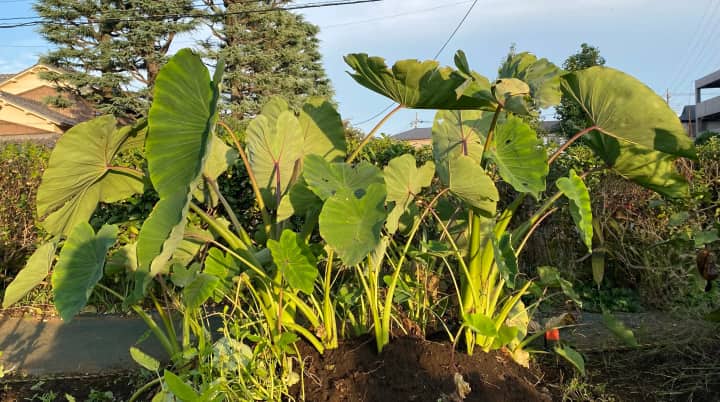
Tokyo's summer turned out to suit taro well. With the heat and strong sunlight, the leaves grew rapidly from July onward — by midsummer, they had become broad and genuinely striking. Several neighbours at the allotment stopped to ask about them, which was quietly satisfying.
Summer care comes down to four things:
- Watering: The soil dries out fast in hot weather. Keep it consistently moist, and for container-grown plants especially, never let it dry out completely.
- Fertilizing: Taro is a heavy feeder. During the peak leaf-growth phase, I fertilized roughly every two weeks. As the season moves into late summer, shift toward a fertilizer with higher potassium to support tuber development.
- Hilling up soil: As plants grow, gently mound soil up around the base. This stabilizes the plant, protects developing tubers, and keeps them from emerging above the surface. Be gentle — avoid digging around to check on underground progress, as disturbing the roots can set things back.
- Preventing the soil from baking dry: Particularly important in containers, where heat can dry out the growing medium quickly.
If you plant in early to mid-May in Tokyo, here's roughly how the season unfolds:
| Period | Growth Stage | Key Focus |
|---|---|---|
| Weeks 2–4 after planting | Establishment | Keep soil moist; hold off on heavy fertilizing while the plant settles. |
| Late June – mid July | Leaf expansion | Leaves grow rapidly; water and fertilize consistently; weed regularly. |
| Late July – September | Tuber development | The most critical stage: maintain steady moisture, increase potassium, and hill up soil in stages. |
| October onward | Maturity | Growth slows as temperatures fall; reduce fertilizing and watering; watch for yellowing leaves before harvesting. |
Autumn: Watching for the Signal
As autumn arrives and temperatures drop, growth slows noticeably. The traditional cue that taro is ready to harvest is yellowing leaves, stems beginning to droop, and a general loss of vigour. In Tokyo, though, I wouldn't wait for the plant to fully die back — once frost hits, the aboveground portions deteriorate quickly, and it can affect the tubers below too.
From late November onward, it's worth watching the weather forecast and picking a clear, relatively dry day to harvest before the first hard frost. You don't need to wait for the plant to look completely spent.
Harvest: The Surprise Underground
I dug mine up in late November. At the time, the leaves were still quite green and the plant looked surprisingly vigorous — not at all like something winding down. But with the season getting colder and frost no longer far off, I picked a good day and got to work.
The approach: start by loosening the soil around the plant's perimeter with a small trowel, then work inward carefully to unearth the main tuber along with the smaller side tubers that develop around it. Move slowly and try not to nick the tubers with the blade.
When the taro finally came out of the ground — there was a genuine little moment of surprise. Actual taro, grown in Tokyo. Smaller than what I'd grown back in Guangdong, yes, but real and solid and undeniably there.
After Harvest: Saving for Next Year
As taro grows, it naturally produces small side tubers around the main one. At harvest time, collect everything — the main taro and all the smaller ones around it. Larger side tubers are good to eat; smaller, healthy ones can be saved and replanted the following spring.
Because Chinese fragrant taro seedlings are genuinely hard to come by in Tokyo, I set a few aside as seed stock rather than risk not being able to source new plants next year.
When choosing which ones to save, look for two things: the tuber should be firm with no soft spots or signs of mould, and it should have a visible growing tip or at least an intact crown where a sprout could form.
📋 Quick Reference: Growing Chinese Fragrant Taro in Tokyo
Planting time
After temperatures are consistently above 15°C — in Tokyo, roughly late April to early May. Planting too early means cold soil and very slow sprouting.
Sunlight
The sunniest spot you can find. Large leaves need strong photosynthesis to fuel tuber development below ground.
Soil
Loose, fertile, well-draining soil. Amend with well-rotted compost before planting. For containers, use a good-quality vegetable potting mix.
Watering
Keep soil consistently moist throughout the growing season. Never let it dry out completely in summer, especially in containers.
Fertilizing
Work in a good base fertilizer at planting time. During the heavy-growth phase, supplement every couple of weeks with liquid or slow-release fertilizer. Switch to a higher-potassium fertilizer in late summer to support tuber development.
Space and containers
Allow around 60 cm between plants and about 100 cm between rows in open ground. For containers, use something at least 40 cm in diameter and 30 cm deep — bigger is always better.
Frost timing and harvest
Tokyo winters are too cold for taro to survive outdoors. Harvest before the first hard frost. Watch for yellowing leaves, drooping stems, and reduced growth. When uncertain, harvest by late November.
Handling note
Raw taro contains calcium oxalate crystals, which can irritate the skin and mouth — this is common to most taro varieties. Wear gloves when handling raw tubers, and cook thoroughly before eating.
🌾 A Small Closing Thought
Growing Chinese fragrant taro in Tokyo was a small experiment I set for myself. By any grand agricultural measure, it wasn't a bumper harvest. But it answered the question I started with: yes, you can do this here.
If you're in Japan and have access to a garden allotment or a generous-sized pot, it's worth trying. For those of us from southern China, it's one way to bring a familiar taste a little closer. For anyone curious about Asian vegetables more broadly, it might just be a genuinely interesting new experience.